How to Hire a Mobile App Development Company: The Complete 2026 Checklist
What does it mean to hire a mobile app development company?Hiring a mobile app development company means partnering with a specialized team — typically made up of developers, designers, QA engineers, and a dedicated project manager — to plan, build, test, and launch a mobile application for your business. Unlike hiring a freelancer or building an in-house team, a development company brings a structured process, a complete team, and full accountability for the final product. In simple terms, you bring the idea and the business goals. They bring the expertise, the process, and the people to turn it into a real, working app. What you will learn in this guide:
|
Factor | What You Need to Know |
Typical cost range | $15,000 – $300,000+, depending on app complexity and developer location |
Average timeline | 4 – 6 months for most apps; 9 – 12+ months for enterprise apps |
Platforms available | iOS, Android, or cross-platform (Flutter / React Native) |
Offshore cost saving | 40 – 60% less than US-based firms with comparable quality |
Development method | Agile with 2–4 week sprints — non-negotiable for quality projects |
IP ownership | You must own 100% of all code and assets — in writing, always |
Post-launch budget | Budget 15–20% of total dev cost annually for maintenance |
AI readiness (2026) | Ask about CoreML, TensorFlow Lite, and OpenAI API experience |
Biggest red flag | Single-number quote with no itemised cost breakdown |
Cynoteck track record | 16+ years, 500+ apps delivered, 90% client retention rate |
Knowing how to hire mobile app developers the right way is one of the most important decisions your business will make in 2026. It is not just another vendor decision — it is choosing a partner who will either help you dominate your market or watch your competitors do it instead. Over 70 per cent of mobile apps fail in their first year because businesses chose the wrong development partner. This guide provides a complete checklist for mobile app development companies to help ensure you do not make the same mistakes.
The mobile app market is racing toward $745 billion by 2030. Your competitors are already building. Users expect flawless experiences from day one. One buggy screen, one confusing interface, one slow load time, and they're gone forever.
This guide reveals exactly how to find, evaluate, and hire a mobile app development company that turns your vision into a market-leading product.
Think about the apps you can't live without. Your banking app, Uber, and Instagram. They feel effortless because the right development teams built them with the right expertise, processes, and vision.
When you choose the wrong partner, you don't just waste development budgets; you also risk losing your market share. Your competitors launch first and capture your market share. Early users experience bugs and never return. Investors lose confidence when you miss critical milestones. Market momentum slips away and becomes nearly impossible to rebuild.
The right development company does the opposite. They translate business goals into features users love. They catch expensive problems before they reach production. They build apps that don't just work today but scale smoothly to millions of users tomorrow.
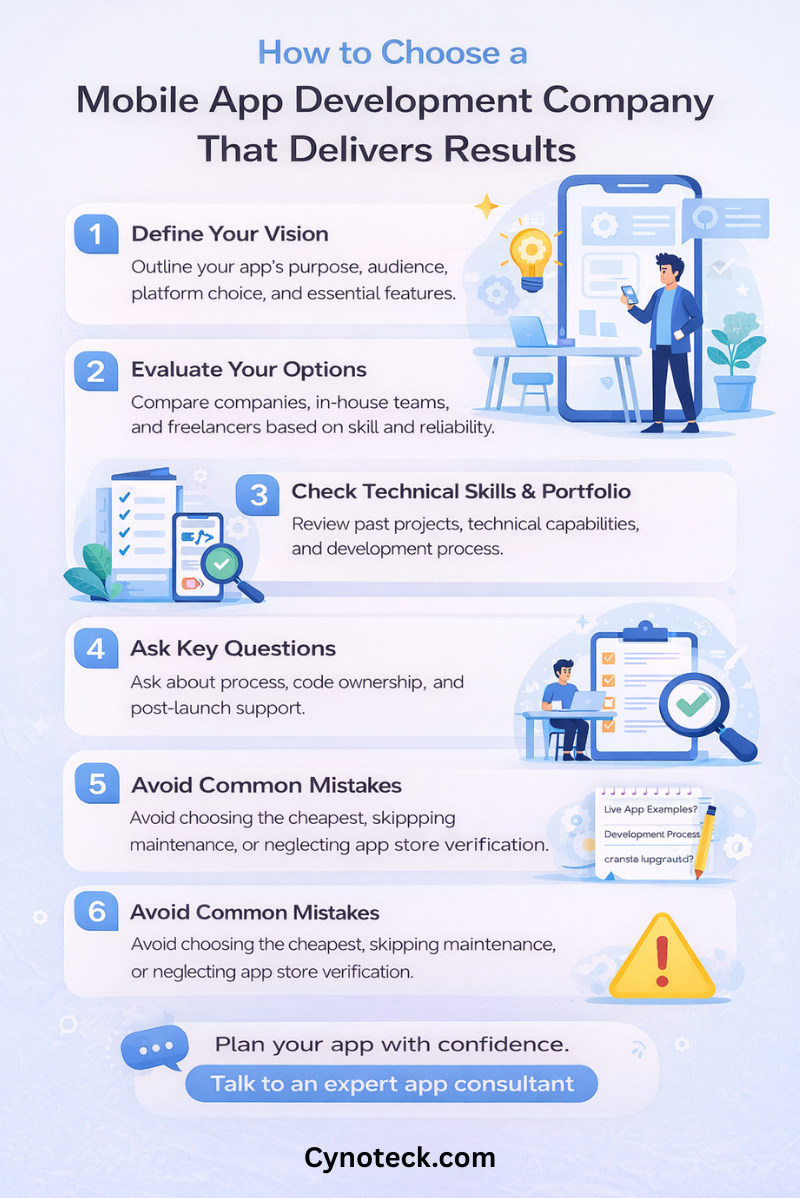
Choosing a mobile app development company is not about who promises the fastest delivery or the lowest cost. It’s about finding a partner that can translate your business goals into a reliable, scalable product.
The right choice reduces risk, protects your investment, and increases the chances that your app succeeds after launch, not just on launch day. Let us share a few simple steps to help you hire professional mobile app developers with confidence.
Get expert guidance on feasibility, costs, and the right development approach before you invest time and money.
Get a Free ConsultationMost entrepreneurs make a critical mistake—they start shopping for mobile app developers before they truly understand what they're building. It's like hiring an architect before you know if you need a house or an office building.
1. Start with the problem you are solving: What specific problem does your app address? If you cannot explain it in one sentence, stop and figure that out first. Every successful app starts with a clear, well-defined problem — not a feature list.
2. Define exactly who will use it: Think about age ranges, locations, daily habits, and income levels. A fitness app for college students requires completely different technology than a healthcare app for retirees. The more specific you are here, the better your app will perform after launch.
3. Choose your platform strategically: iOS, Android, or both? If 80 percent of your target audience uses iPhones, launch on iOS first. Prove the concept, gather real feedback, then expand to Android based on actual demand — not assumptions.
4. Decide between an MVP and a full app: An MVP launches quickly with only the core features, letting you test with real users before committing to the full build. Most successful apps start as MVPs, validate demand early, and then scale based on what users actually want.
5. Budget realistically before you start talking to anyone: Simple apps cost $15,000 to $25,000. Medium complexity apps run $25,000 to $85,000. Complex enterprise apps cost $85,000 to $300,000 or more. Quality also takes time — plan for a minimum of four to six months for most projects.
App Type | Cost Range (USD) | Timeline | Typical Features |
Simple app | $15,000 – $25,000 | 3 – 4 months | Single platform, basic UI, limited backend |
Medium-complexity app | $25,000 – $85,000 | 5 – 8 months | User accounts, API integrations, backend, push notifications |
Complex / enterprise app | $85,000 – $300,000+ | 9 – 12+ months | Multi-platform, compliance (HIPAA/PCI), AI features, advanced integrations |
MVP (first version only) | $20,000 – $50,000 | 3 – 5 months | Core features only — built to validate, not to scale |
Offshore (same specs) | 40–60% less than above | Same as above | Quality depends on process discipline, not location |
Budget an additional 15–20% of your total development cost each year for post-launch maintenance. This covers OS updates, security patches, bug fixes, and new feature development. Skipping this results in an app that becomes incompatible with new devices and OS versions within 12–18 months of launch.
You have three fundamental choices: freelancers, in-house teams, or development companies. Each carries serious implications for your project's success.
Freelancers charge the least, typically $50 to $150 per hour, and work great for small projects or quick prototypes. The risk? If they disappear mid-project (and many do), you're stuck with half-finished code nobody else can decipher. There's no team to absorb workload if they get sick, no backup if they underestimate the complexity.
In-house teams give you maximum control but at a high cost. You're paying salaries, benefits, office space, equipment, management overhead, plus the time and expense of recruiting skilled developers in a competitive market. In-house teams only make financial sense if you're building a product company where the app fundamentally IS your business.
Mobile app development companies hit the sweet spot for most projects. Yes, they cost more upfront than freelancers. But you get a complete team—designers who understand user psychology, iOS and Android developers who know platform-specific quirks, QA testers who catch problems before users do, and project managers who keep everything on track.
More importantly, you get accountability. Companies have reputations to protect, processes tested across hundreds of projects, and backup developers if someone leaves mid-project. For business-critical apps where deadlines matter and quality can't be compromised, professional development companies dramatically reduce your risk.
Factor | Freelancer | In-House Team | Development Company |
Cost | $50–$150/hr (lowest) | Highest (salary + benefits + overhead) | Mid–high upfront, best ROI overall |
Speed to Start | Fast | Slow (hiring takes months) | Fast (team is ready now) |
Accountability | Low — no backup if they leave | Medium — internal management needed | High — company reputation on the line |
Team Depth | Single developer only | Depends entirely on who you hire | Full team: design, dev, QA, PM included |
Risk Level | High | Medium | Lowest |
Post-Launch Support | Rarely included | Available but expensive | Usually packaged and structured |
Best For | Prototypes, small tasks | Core product companies | Business-critical apps |
The location debate matters less than you think. What actually matters is whether they have bulletproof processes and clear communication systems. A disorganized local team causes more problems than a disciplined remote team with daily updates and precise documentation. Offshore teams often cost 40-60% less while delivering comparable quality—if they have strong processes.
In 2026, offshore mobile app development has matured significantly. Teams in Eastern Europe and South Asia now regularly deliver enterprise-grade applications for US and UK businesses — at 40 to 60 percent lower cost than domestic development firms. The key is not where the team is located. The key is whether they have bulletproof communication processes, documented project management practices, and a verifiable track record of delivering on time for international clients.
This is your core checklist. Use it to filter candidates and find the right mobile app development firm for your project. Here's how to evaluate potential development partners systematically:
Understanding native versus cross-platform development matters significantly. Native apps (Swift for iOS, Kotlin for Android) deliver the best performance but require twice the build time. Cross-platform tools like Flutter or React Native can cut costs by 30-40% by sharing a single codebase across both platforms.
Ask every company: "What technology do you recommend for my app and why?" Watch for companies that explain trade-offs honestly, rather than those that push their preferred tech stack regardless of your needs.
Your app needs solid backend infrastructure. Look for experience with AWS, Google Cloud, or Azure. Design deserves equal attention—88% of users abandon apps after bad experiences, and that's usually about design, not bugs.
In 2026, also ask whether the team has experience with AI-ready development — including frameworks like CoreML, TensorFlow Lite, or third-party AI APIs — as AI features are increasingly a baseline expectation rather than a premium addition.
Don't just browse website galleries. Demand live apps similar to yours, download them personally, and use them like a real user. Do they load fast? Crash? Feel intuitive? Read app store reviews for actual user feedback.
Industry experience matters enormously. Fintech apps require payment processing expertise. Healthcare apps need HIPAA knowledge. E-commerce apps need conversion optimization skills. Read case studies that explain the original problem, their solution, and measurable results.
For reference: Cynoteck’s mobile app portfolio spans 500+ completed projects across healthcare, fintech, retail, and enterprise software. When evaluating any company’s portfolio, look for a similar spread of industries and complexity levels — not just volume. A company that has built 200 simple apps is not the same as one that has built 50 complex, compliant, enterprise-grade applications.
Agile methodology is non-negotiable. Agile means 2-4 week cycles where you see working features, provide feedback, and the team adjusts. If they mention "waterfall," walk away immediately.
You need complete visibility: weekly updates with actual progress, a dedicated project manager, 24-hour response times, and access to tools like Jira that show real-time status. Testing must be continuous—automated suites, manual QA on multiple devices, and beta testing before launch.
Never accept a single number. Demand itemized breakdowns: design (15-20%), frontend development (30-40%), backend (25-35%), testing (10-15%), and project management (10%).
Then ask: "What's NOT included?" Mobile app development hidden costs include app store fees ($99/year for Apple, $25/year for Google), third-party services, server hosting ($50-500/month), and post-launch maintenance (budget 15-20% annually).
If working with offshore teams, insist on video calls with actual developers, not just salespeople. Test their ability to explain complex concepts in understandable terms. Poor communication kills more projects than destructive code.
These questions separate companies with substance from those with just marketing polish. Therefore, ask these critical questions during every evaluation call when hiring mobile app developers. Good answers show experience. Vague answers show problems.
"Can you share live apps similar to mine?" – Get specific names and links. Download them. If they hesitate, that's your answer.
"What development process do you follow?" – Listen for Agile, Scrum, and sprints. Anything else is a red flag.
"How do you handle scope changes?" – Every project hits surprises. Companies with mature processes clearly explain how they manage change.
"What happens after launch?" – Apps need ongoing maintenance. Companies avoiding this topic are hiding costs.
"Can I talk to three past clients?" – Confident companies connect you immediately. Hesitation means hidden problems.
"Who owns the code when we're done?" – YOU must own all code and IP, in writing, no exceptions.
"Do you have experience building AI-ready apps and handling App Store approval from day one?" — Teams that build with platform guidelines in mind from the start avoid costly rejections and delays at submission. This question also reveals whether the company is keeping pace with the 2026 development standards.
Get expert input on development approach, costs, and risks so you can choose the right mobile app development partner.
Get a Free ConsultationLearn from others who learned the hard way. Here, we will highlight a few common mistakes that users usually make when hiring a mobile app development company.
Mistake 1: Choosing the cheapest option – That $30,000 app that fails costs more than a $100,000 app that succeeds. Cheap developers cut corners, skip testing, or disappear mid-project.
Mistake 2: Ignoring maintenance – Apps don't maintain themselves. Apple and Google release new OS versions constantly. Your app needs updates to stay compatible.
Mistake 3: Skipping app store verification – When companies show portfolio apps, search those apps in stores and read real user reviews. Low ratings and bug complaints expose quality issues they won't mention.
Mistake 4: Starting without a contract – Never begin without written agreements covering scope, timeline, payment terms, IP ownership, and exit procedures. Have a lawyer review everything.
Mistake 5: Not meeting the actual development team – Sales people don't build apps—developers do. Insist on meeting the people who'll actually write your code.
Mistake 6: Not asking about 2026-specific capabilities. AI integration, App Store compliance from day one, and CI/CD deployment pipelines are now standard expectations — not advanced features. A company that cannot speak to these areas confidently is behind the curve and will slow your project down.
Not every mobile app development company that looks good on paper will deliver a good app. These are the warning signs that matter most. If you see any of these during your evaluation, treat it as a hard stop.
Red Flag 1: A single quote with no itemized breakdown.
Any serious company can break down their quote by design, development, QA, and project management. If they give you one number and refuse to explain how it was calculated, they are hiding something.
Red Flag 2: Delivery promises under two months for a complex app.
Rushed development means skipped QA. Those shortcuts show up as bugs, crashes, and App Store rejections after launch.
Red Flag 3: Resistance to full IP ownership.
If they hesitate to confirm in writing that you own 100% of all code, designs, and assets upon completion, walk away. No exceptions.
Red Flag 4: No verifiable live apps in their portfolio.
A real portfolio shows apps you can download, test yourself, and read actual user reviews for. Screenshots and mockups prove nothing.
Red Flag 5: Unwillingness to connect you with past clients.
Confident companies connect with you immediately. Hesitation means there are past clients they do not want you talking to.
Red Flag 6: No mention of Agile methodology.
If they describe their process as ‘waterfall’ or cannot explain how they handle mid-project scope changes, you will wait months for a reveal with no chance to course-correct.
Red Flag 7: Claiming apps are ‘maintenance-free.’
Every app needs regular updates for OS compatibility and security patches. Any company claiming otherwise is either inexperienced or hiding future costs.
Red Flag 8: You never meet the actual developers.
Salespeople do not build apps. Developers do. If they will not put you on a call with the people writing your code, that is a serious structural problem.
Red Flag 9: No answer on 2026-specific capabilities.
AI-ready development, CI/CD pipelines, and App Store compliance from day one are baseline expectations in 2026. A company that cannot speak to these confidently is already behind the curve.
2026 has changed what good mobile app development looks like — and it has changed what you should look for when you hire.
Users now spend over five hours a day on their devices, but their tolerance for poor software has reached an all-time low. Apple reviews over 7.7 million app submissions annually and rejects nearly 25 percent of them — not just for technical glitches but because the stores are actively filtering out low-quality experiences. The bar for what constitutes a quality app has risen significantly — and so has the bar for the team you choose to build it.
When evaluating any development company in 2026, ask these three additional questions that most buyers overlook:
Most competitive apps in 2026 are expected to include AI features such as personalized recommendations, smart search, automated responses, and on-device intelligence. Ask whether their developers have experience with tools like CoreML for iOS, TensorFlow Lite for Android, or third-party AI APIs like OpenAI. A team without this experience will slow you down as AI becomes a baseline expectation rather than a premium add-on.
A surprising number of development teams build apps without factoring in App Store and Google Play review guidelines until submission, which leads to costly delays and last-minute fixes. Ask specifically how they incorporate platform guidelines into their development and testing process.
Continuous integration and continuous deployment mean your app can be updated quickly and reliably after launch without breaking existing functionality. Teams that use automated deployment pipelines deliver faster, safer updates and are significantly less likely to introduce bugs during maintenance cycles.
A contract is not just a formality — it is your only protection if things go wrong. Before you sign anything with a mobile app development company, make sure every one of these items is covered in writing.
You must own 100% of all code, designs, assets, and documentation upon project completion. This must be stated explicitly in the contract — not implied. If a company pushes back on this, walk away immediately.
Never agree to pay in large upfront lump sums. Structure payments around specific milestones — completion of design, delivery of the working prototype, launch on the App Store, and post-launch support. This protects your budget if the project stalls.
Every project evolves. Your contract must clearly define how scope changes are requested, approved, and priced. Without this, any small change becomes an opportunity to inflate the budget without accountability.
Any company building your app will have access to your business logic, user data architecture, and competitive ideas. A non-disclosure agreement protects this information before the project even starts.
If the relationship breaks down, what happens? Who holds the code? What is the handover process? How is the final payment calculated? A clear exit clause protects both sides and makes transitions far less painful.
Confirm exactly what is covered after launch — bug fixes, OS compatibility updates, response times for critical issues — and for how long. "We will support you after launch" is not a contract term. Specific timeframes and service levels are.
One additional clause worth adding in 2026, specifically, ownership of any AI-generated code. If your development partner uses AI tools during the build, confirm in writing that all AI-generated output is included in your IP ownership agreement.
Here's what most hiring guides miss—the real test of a development company isn't just what they build, but how their apps perform six months after launch. This insight gives you a massive competitive advantage when evaluating potential partners.
Anyone can build an app that works on launch day. The companies worth hiring build apps that thrive long after launch. Ask potential partners these specific questions:
"What's the average app store rating of your apps six months after launch?" Strong companies maintain 4+ star ratings because they build quality from day one. Declining ratings reveal hidden technical debt and poor planning.
"Show me the user retention metrics for three similar apps." Apps losing 80% of users in week one weren't built right. Companies confident in their work proudly share retention data.
"How many of your apps required complete rebuilds within the first year?" This question makes weak partners squirm. Quality companies rarely rebuild because they architect correctly from the start.
Professional mobile app development companies proactively discuss maintenance because they understand that app success requires ongoing commitment. Ask about their maintenance packages and post-launch support structure.
Red flag: Companies claiming "maintenance-free" apps or pushing you to "deal with that later." Quality apps need regular updates to maintain OS compatibility, address security vulnerabilities, and add new features—budget 15-20% of the development cost annually for proper maintenance.
Green flag: Companies presenting clear maintenance roadmaps, explaining how they handle emergency bugs, and offering service level agreements for response times.
Before committing to any mobile app development company, make sure every one of these is confirmed in your contract, not just mentioned verbally:
Bug fixing — covered for how long and at what response time?
OS compatibility updates — when Apple or Google releases a new version, who updates your app and at what cost?
Security patches — are critical security fixes covered under the maintenance package?
App Store compliance — if your app is rejected after a platform policy update, who fixes it?
Performance monitoring — do they use Firebase or Mixpanel to track crashes and behaviour after launch?
Feature updates — what is the process and cost for adding new features post-launch?
Service level agreement (SLA) — do they commit to defined response times for critical issues?
Any app development company that says “we’ll handle support after launch” without specifying these terms is not giving you a commitment. It is a placeholder. Get every item above confirmed in writing before you sign.
Ask: "What percentage of apps you built three years ago still operate without major technical overhauls?"
Strong answer: "The majority run smoothly with routine updates." This reveals they choose stable, scalable technologies and build sustainable architecture.
Weak answer: Vague responses, deflecting to specific circumstances, or admitting that most apps needed major rewrites. This exposes poor technology choices or rushed development that cut corners.
Shortlist two or three mobile app development companies that meet your technical, budget, and communication expectations. Then slow the process slightly. Most costly mistakes happen right before signing.
Your final choice should be a mobile app development partner that aligns with your business goals, not just your technical requirements.
1 Call references directly: Ask past clients – Did projects finish on time? How was communication really? How did they handle unexpected problems? Would you hire them again?
2 Review contracts: Ensure YOU own all code and designs when projects end. Verify payment milestones tie to actual deliverables. Understand the exit procedures if relationships don't work out.
3 Consider a paid discovery phase: Some companies offer 2-4 weeks of planning first ($5,000-15,000). You see their process quality before committing full budgets. Worth every penny for complex projects.
Verify security expertise if handling sensitive data. Ask specifically about their security practices, compliance experience, and data protection measures.
The professional mobile app development companies cost more than freelancers. But the numbers tell a clear story. Businesses that partner with experienced development teams achieve 20 to 30 per cent higher app retention rates — which directly impacts revenue, customer lifetime value, and competitive positioning.
The right partner does not just build what you ask for. They challenge assumptions, catch expensive problems before they reach production, and build apps designed to scale — not just launch. That is the difference between an app that performs for years and one that requires a costly rebuild 12 months in.
You now have everything you need to make this decision with confidence. Define your requirements clearly. Research companies using the checklist in Step 3. Ask the critical questions from Step 4. Check references thoroughly. Review every contract clause before signing.
The right mobile app development partner turns your idea into a product users genuinely love — and builds a foundation your business can grow on for years. Choose wisely.
At Cynoteck, we apply all of these standards to our work. With over 16 years of mobile app development experience, 500-plus projects delivered across healthcare, retail, fintech, and enterprise software, and a 90% client retention rate, we bring the expertise, process discipline, and post-launch commitment described in this guide. If you want a partner who has already passed the checklist you just read — get in touch with our team today.
Partner with experienced mobile app developers who focus on execution, scalability, and long-term business results.
Get a Free ConsultationChoosing the right mobile application development services partner is not about speed. It is about strategy, execution, and trust. The right mobile application development services partner understands your business, not just your codebase.
If you want clarity on cost, timelines, and the right technical approach, talk to our experts.
Talk to our mobile app development experts now.
Build with confidence. Build with the right partner.
A: Yes — for any app that matters to your business. A professional mobile app development company brings architecture expertise, product design experience, a structured delivery process, and post-launch support that freelancers or internal teams rarely match. Over 70% of mobile apps fail in their first year, most often because of the wrong development partner. For business-critical apps where quality, reliability, and scalability are non-negotiable, hiring a professional development company is almost always the smarter, safer long-term investment.
A: A mobile app development company is a specialist agency that plans, designs, builds, tests, and launches mobile applications for businesses. Their team typically includes product managers, UI/UX designers, iOS and Android developers, QA engineers, and a dedicated project manager — all working under a structured development process. Unlike a freelancer who works alone, a development company manages the entire app lifecycle from the first planning session through to App Store submission and post-launch support. They are the right choice for businesses that need a reliable, scalable, professionally built app without the cost and complexity of managing an internal technical team.
A: In 2026, the mobile app development cost ranges from $15,000 for a simple single-platform app to $300,000 or more for a complex enterprise application. Medium-complexity apps with user accounts, third-party integrations, and a backend typically cost $25,000 to $85,000. Offshore development teams in Eastern Europe or South Asia often charge 40–60% less than US-based firms for comparable quality. Always request a fully itemised quote — never accept a single number. Budget an additional 15–20% of your total development cost each year for post-launch maintenance, OS compatibility updates, and security patches.
A: Start by downloading and testing real apps from their portfolio — never rely on screenshots alone. Check app store ratings and read user reviews for those live apps. Ask to speak with three past clients directly. Confirm they use Agile methodology, which means you see real working progress every two to four weeks. Verify in writing that you will own 100% of all code and intellectual property. Test their communication quality in your first call. A company that explains technical decisions clearly in plain business language is far more likely to run a smooth, on-time project.
A: A freelancer is a single developer working independently at a lower hourly rate. They suit small, simple projects but carry high risk for anything complex or business-critical. If a freelancer falls ill, gets overbooked, or walks away mid-project, your app stalls with no backup. A mobile app development company provides a full team — designers, developers, QA engineers, and a project manager — under one accountable structure with tested processes and backup resources. For any app where quality, deadlines, and long-term support matter, a professional development company reduces your risk significantly.
A: Ask these in every evaluation call: Can you share live apps similar to mine that I can download and test? What development methodology do you use? How do you handle scope changes mid-project? Who owns all the code when the project is complete? Can I speak directly with three past clients? What does post-launch support include and at what cost? Do you have experience with AI-ready app development and App Store compliance from day one? Strong companies answer every question with specific detail. Vague answers are a reliable signal that the company is not mature enough for a business-critical project.
A: Most mobile apps take between four and six months to develop from initial planning to App Store launch. Simple apps with limited features can be completed in three to four months. Medium-complexity apps with user authentication, integrations, and a backend typically take five to eight months. Enterprise-grade apps with advanced features or multi-platform support take nine to twelve months or longer. Any company promising delivery in six weeks or less for a complex app is almost certainly cutting corners on QA testing. Those shortcuts show up as bugs, crashes, and App Store rejections after launch.
A: A solid contract must cover six things at a minimum:
Full IP ownership — 100% of all code, designs, and assets belong to you, stated explicitly.
Milestone-based payment terms tied to actual deliverables, not lump sums.
A defined scope change process with clear approval steps.
A non-disclosure agreement protecting your business logic.
An exit clause defines code handover if the relationship ends early.
Specific post-launch support terms, including what is covered and at what response time.
In 2026, also confirm ownership of any AI-generated code used during the build.
A: Location matters far less than process quality and communication discipline. An offshore company with clear communication systems, documented processes, and a verifiable track record for international clients will outperform a disorganised local team every time. Offshore teams in Eastern Europe and South Asia routinely deliver enterprise-grade mobile apps for US and UK businesses at 40–60% lower cost without sacrificing quality. The factors that matter are communication systems, project management tools, verifiable client references, and a portfolio of live apps you can test yourself.
A: Nine red flags to watch for: a single-number quote with no breakdown; delivery promises under two months for complex apps; resistance to full IP ownership; no verifiable live apps in their portfolio; unwillingness to connect you with past clients; no mention of Agile methodology; claims that apps are maintenance-free; you never meet the actual developers; and no confident answer on AI-ready development, CI/CD pipelines, or App Store compliance. In 2026, those last three are baseline capabilities — any company without them is already behind.
A: Start with your target audience, not your personal device preference. If 80% or more of your users are on iPhones, launch on iOS first. If you are targeting global markets or emerging economies where Android dominates, Android has far broader reach. Cross-platform development with Flutter or React Native lets you build one codebase for both platforms, cutting costs by 30–40% compared to two separate native apps. The proven approach: launch on one platform, validate demand with real users, then expand based on actual results — not assumptions.

Mobile healthcare apps improve patient care by enabling remote monitoring, timely reminders, secure data access, better communication, and cost-efficient healthcare services through mHealth technology.
B2B apps help businesses streamline operations, enable on-the-go access to data, improve client engagement, support omnichannel sales, and drive scalable revenue by simplifying complex business workflows.

Learn the complete mobile app development process in 2026 — from idea to launch. Covers all 10 steps, timelines, costs, native vs cross-platform, and how to choose the right development partner.
We are more than just developers and consultants—we are your partners in navigating the digital landscape. Let us be the engine behind your next big success while you focus on your core vision.
Explore Opportunities!
 Mobile App Development Cost Breakdown by App Type, Features, and Complexity (2026).png)