A Quick Intro to Artificial Intelligence (AI) & Its Components
Artificial intelligence, in simple words, AI is a computer science to create machines as smart and capable as humans with the help of algorithms designed to make decisions using real-time data.
It refers to the combination of concepts and technologies, with its applications everywhere you look at, like – robots that impersonate humans, self-driving cars, machine learning, and more.
Artificial intelligence (AI) builds intelligent and capable machines to think like humans, learn by themselves, and reach conclusions with their instant analysis.
These AI systems empower businesses to leverage large volumes of available data to extract insights and patterns that would be impossible for any person to identify, allowing them to deliver more personalized communications, identify possible fraudulent transactions, and more.
In everyday life, Artificial intelligence is successfully expanding around us in various perspectives like education, communication, healthcare, marketing, traffic control, purchasing, and more.
Artificial intelligence sets the basis for all computer learning and is the future of complex decision-making. These machines are remarkably effective at calculating any combinations and permutations to reach the best decision. Deep Learning and AI are the foundational future of business decision-making.

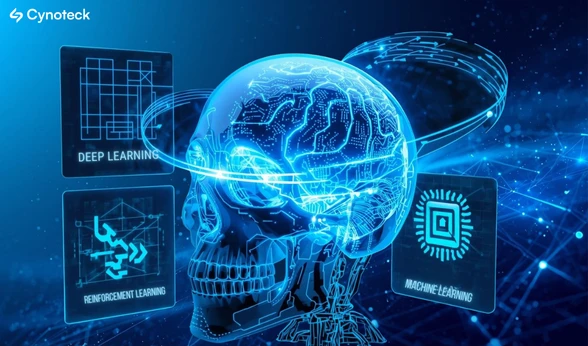
Artificial Intelligence has three main components, which we are going to discuss in the section below.
Machine learning is based on algorithms where a machine learns from previous data and past actions. It begins with the observations of data to look for patterns in data and makes better decisions accordingly.
Machine learning gives computers the ability to analyze and sort large volumes of data. The process begins with data, instructions, and observations to make better decisions in the future.
Deep learning is a subset of AI and ML which is inspired by the structure and function of the human brain, with neuron nodes connected like a web. Deep learning is the technology used behind driverless cars.
Machine learning prepares machines to do what humans are naturally born with, to accomplish tasks quickly from sound, images, or text, with incredible accuracy, sometimes more than human-level performance.
Reinforcement learning is all about making decisions sequentially to maximize reward in any particular situation. A reinforcement algorithm learns by interacting with its environment; the output here depends on the state of the current input.
Reinforcement learning is goal-oriented and can be used for tasks with objectives like self-driving cars or robots playing soccer, and more. It also adapts to new environments automatically.
Artificial Intelligence (AI) helps in solving problems that humans cannot handle at the same speed and scale. Many businesses use it to work more efficiently. Moreover, AI scans a huge amount of data within seconds, enabling companies to save time, cut costs, and deliver better outcomes.
Nowadays, various industries are using AI or AI applications, such as healthcare, banking, education, marketing, etc. These industries implement Artificial Intelligence to reduce errors, speed up work, and improve decision-making.
Here are the four main strengths that make it important in everyday life:
Speed: AI is capable of analyzing and processing much faster compared to humans. It makes complex tasks possible within seconds that can be challenging for humans.
Accuracy: For humans, there are chances of errors. However, AI works with the right data, helping in reducing errors and providing accurate results.
Automation: It automates various tasks, making people focus on higher-value work, so they can work efficiently.
Better Decisions: Artificial Intelligence has the capability of identifying patterns and trends that humans may miss. This support them to make smarter decisions.
That is why AI plays an important role in everyday life, and it can solve complex tasks quickly without any hassles.
There are a lot of advantages to artificial intelligence in our day-to-day lives across all industries. Moreover, AI can work 24 hours because it does not need to sleep, like humans do. This allows you to operate without breaks and work with full efficiency.
It helps you to reduce workload and speed up tasks that take hours or days manually.
Artificial Intelligence works with full accuracy and can process a lot of data without a single error.
You can do manual tasks, such as scheduling, data entry, or analyzing thousands of documents within minutes.
AI also helps in critical tasks, including bomb disposal, space exploration, or mining, where human safety would be at high risk.
Moreover, there are more advantages of Artificial Intelligence across various industry sectors. Let us now discuss a few common limitations of AI.
As there are a lot of advantages of Artificial Intelligence, there are also some limitations of AI that you must know.
High cost of development: AI is a powerful solution for various tasks, but it comes at a high cost of development. From hardware to skilled professionals and maintenance, the cost could be too high for businesses.
Dependency and affected human skills: As AI can handle almost all tasks with accuracy, it can make people depend on AI applications or machines. Moreover, it can also reduce human skills, such as decision-making, problem-solving, etc., if you are unable to balance them properly.
Data privacy issues: Artificial Intelligence handles a large amount of data that holds sensitive and personal information. Therefore, there can be chances of privacy violation; so, make sure to protect critical data from privacy concerns.
These are the common concerns of AI that you should manage to balance and work without any risks.
Artificial intelligence (AI) has been pushing the limits of machine-enabled functionalities. This technology helps machines to work with autonomy, resulting in the effective execution of iterative tasks.
AI facilitates the formulation of a next-generation workplace that increases seamless collaboration between the business system and individuals.
AI provides businesses with an abundance of resources to free up for higher-level tasks. AI runs down the time taken to perform a task, enables multi-tasking, and reduces the workload for existing resources.
AI runs 24×7 without interference, delay, or breaks, and has no downtime. AI improves decision-making by making the process smarter and faster.
So, with the help of AI, we can overcome various risky limitations of humans by developing an AI Robot that can perform exceptional tasks like going to Mars, exploring the deepest parts of oceans, defusing a bomb, mining for fuel and coal, and it can also be used efficiently in all kinds of man-made or natural disasters.
Understand how AI analyzes data, detects patterns, and supports better, faster decision-making.
Start Your AI JourneyQ1. What is Artificial Intelligence in simple words?
A: Artificial Intelligence, in simple words, is a computer science of designing smart and capable machines to think, learn, and solve problems like humans.
Q2. What are the 3 main components of AI?
A: Here are the 3 main components of AI:
Machine Learning
Deep Learning
Reinforcement Learning
Q3. How is AI used in daily life?
A: There are many uses of Artificial Intelligence in daily life, including customer support, chatbots, online shopping, spam filtering, etc.
Q4. Why is AI important for businesses?
A: It empowers businesses and helps them to save time, boosts efficiency, reduces costs, and enhances decision-making.
Q5. What is the future of AI?
A: The future of AI includes working alongside humans, improving the healthcare sector, driving innovation, and even supporting complex tasks, like space exploration.
What is Artificial Intelligence? Artificial intelligence (AI) is intelligence demonstrated by machines, which makes it possible for machines to learn from experience, adjust to new inputs and perform human-like tasks.
We are more than just developers and consultants—we are your partners in navigating the digital landscape. Let us be the engine behind your next big success while you focus on your core vision.
Explore Opportunities!


 What is Agentforce A Complete Guide.webp)