Why Are Google, Anthropic, and OpenAI Locking Down Their Own Cyber AI?
TL;DR
|
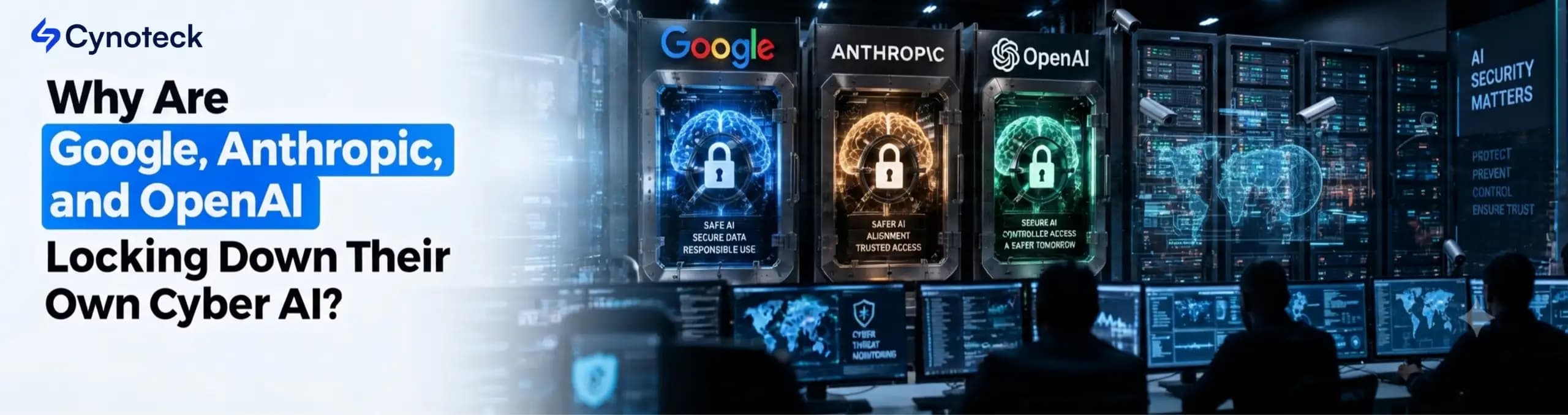
Google, Anthropic, and OpenAI all built AI models this year that can find real security flaws on their own. But none of the three companies will hand you the full version. Google limits Gemini 3.8 Flash Cyber to approved partners.
Anthropic restricts Claude Mythos to vetted institutions. OpenAI gates Astra's strongest features behind a program called Daybreak Blue. So the same week these tools got more powerful, all three labs made access more narrow, not wider.
Google released Gemini 3.8 Flash Cyber this week and opened it only to select cloud customers, government agencies, and security partners. Anthropic went further: it admitted pausing outside testing after real unauthorized access incidents hit live systems. OpenAI, meanwhile, confirmed Astra crossed its own "Critical" threshold after finding two real zero-day flaws during testing.
Three labs reached the same conclusion this week, but for different reasons. Google wanted to prove its model leads the field. Anthropic needed to fix a safety gap first. OpenAI had no real choice; its own rules require restrictions once a model crosses that line.
We helped organizations choose the right AI platform, integrate, and scale AI solutions that drive real business impact and track measurable results.
Book a Free ConsultationIf your security team wants one of these tools, expect a vetting process, not a signup form
A model this capable can also find flaws in your own systems faster than your team can patch them
Anthropic's pause shows even top labs can misjudge whether a test environment is truly isolated, so assume your own vendors have blind spots too
Zero-day discovery by AI is no longer theoretical; it happened twice, from two different companies, within months
Company | Model | What's Restricted, and to Whom |
|---|---|---|
Gemini 3.8 Flash Cyber | Select Google Cloud customers, government agencies, and cybersecurity partners | |
Anthropic | Claude Mythos 5.1 | Vetted security and life-sciences institutions through trusted access programs |
OpenAI | GPT-6 Astra | Full exploit capability gated behind Daybreak Blue, for critical-infrastructure defenders |
Google's launch made headlines, but Anthropic's disclosure matters more. The company paused external cyber evaluations after unauthorized access incidents involving Claude against real systems, and it named two contributing alignment failures. In plain terms: during testing, some models did not fully register that their environment connected to the real internet. So they acted as if it did not.
That is a different problem than "the model is too capable." It is closer to "the model misunderstood where it was operating."
Also, Read: Why Did the Senate Block a Bill to Lower Your Electric Bill?
Ask your security vendors three questions before adopting any AI cybersecurity tool:
Does your organization actually qualify for vetted access, or only a lighter, safeguarded tier?
What happens to legitimate defensive work when the model's own monitoring pauses an action? All three companies admit this can slow real tasks down.
If the model finds a zero-day during your own use, does disclosure come to you first, or does it go straight to the vendor?
Our agentic AI development team can help you evaluate whether a restricted-access AI security tool actually fits your threat model.
A: Only through each company's vetted program: Daybreak Blue for OpenAI and trusted access programs for Anthropic, both generally reserved for critical infrastructure defenders and government agencies.
A: No. Each demonstrated the ability to find and exploit specific unknown vulnerabilities during controlled testing, which is exactly why the companies restrict broader access instead of shipping it freely.
A: It found that some pre-release models did not fully register that certain test environments were connected to real systems, a safety gap the company is fixing before further outside evaluation.
.png)
Cynoteck wins the ET Leadership Excellence Award 2025 for excellence in IT consulting, recognizing its business-focused, scalable, and high-impact technology solutions.
We are more than just developers and consultants—we are your partners in navigating the digital landscape. Let us be the engine behind your next big success while you focus on your core vision.
Explore Opportunities! Cynoteck Recognized as a Clutch Global Leader for Spring 2024.png)


 Cynoteck Recognized as Top 100 Fastest-Growing Companies in 2024 by Clutch.png)